How it works
Migration is more than moving data.
A structured process helps make financial-data migration visible, controlled and easier to verify — from early readiness through to approved cutover.
Ledrix is not a file converter. It is the governed layer around a financial-data migration: the assessment, the decisions, the run, the evidence and the approval.
Specific workflow capability is being introduced progressively and depends on the relevant migration route.
01
Assess
Condition, complexity, risk
02
Prepare
Decisions, owners, scope
03
Migrate
Controlled runs, exceptions
04
Validate
Comparison and evidence
05
Cut over
Approval and go-live
Assess
The Ledrix approach starts by understanding the condition of the source data — not assuming it.
What Ledrix is designed to manage
- Profile of accounts, ledgers, transaction volumes and history depth
- Indicators of data condition, duplication and structural complexity
- Risks that typically cause rework later in a migration
What you decide
- How much history is genuinely required in the new system
- Which entities, ledgers or subsidiaries are in scope
- Who owns the outcome on the business side
Expected outputs and evidence
- Readiness overview
- Complexity and risk summary
- Initial scope position
Why it lowers risk: Surprises found during assessment cost far less than surprises found during cutover week.
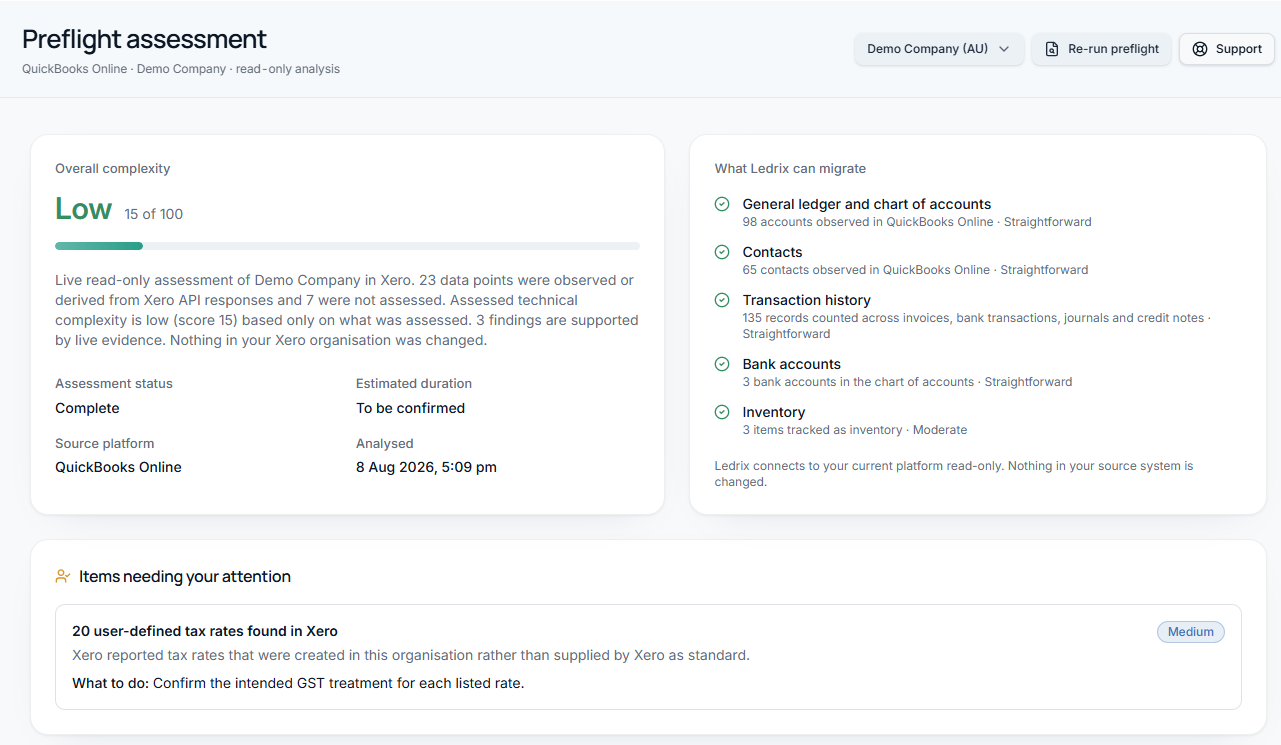
Prepare
Preparation turns findings into a plan with named owners, sequenced actions and agreed scope.
What Ledrix is designed to manage
- Cleanup items and the order they should be handled in
- Mapping decisions that need a person, not a default
- Scope boundaries and what is deliberately excluded
What you decide
- Which cleanup happens in the source system versus during migration
- How the chart of accounts and tax codes should map
- Who signs off scope before the migration begins
Expected outputs and evidence
- Preparation plan
- Decision register
- Agreed migration scope
Why it lowers risk: Decisions made deliberately up front are cheaper than decisions improvised mid-migration.
- Open
Chart of accounts mapping
Owner — Finance lead
- Decided
History depth to migrate
Owner — Business owner
- Open
Tax code treatment
Owner — Accountant
- Decided
Entities in scope
Owner — Finance lead
Migrate
The migration itself runs as a controlled, traceable process rather than a one-shot import.
What Ledrix is designed to manage
- Sequenced runs with a record of what was processed and when
- Exceptions held for review rather than silently skipped
- A traceable link between source records and destination results
What you decide
- How held exceptions should be treated
- Whether to proceed, pause or re-run a batch
- Timing of runs against business activity
Expected outputs and evidence
- Run history
- Exception queue
- Processing record
Why it lowers risk: Traceability means a difference can be explained instead of investigated from scratch.
- Complete
Chart of accounts
- Complete
Opening balances
- Complete
Transactions 2024
- 62%
Transactions 2025
- Queued
Payroll history
Validate
Validation is where a migration earns trust. The workflow is designed to make the comparison explicit.
What Ledrix is designed to manage
- Record counts compared between source and destination
- Balance comparison across key accounts and control totals
- Mapping and transformation decisions recorded alongside results
- Identified exceptions, their investigation and their resolution
What you decide
- Whether a difference is an error, an expected transformation or an accepted variance
- What evidence is required before sign-off
- Who reviews and who approves
Expected outputs and evidence
- Comparison summaries
- Exception investigation notes
- Evidence to support review and sign-off
Why it lowers risk: Evidence gathered as you go is what makes a confident approval possible — rather than a hopeful one.
| Measure | Source | Destination | Result |
|---|---|---|---|
| Trial balance | 1,842,110.42 | 1,842,110.42 | Matched |
| Accounts receivable | 218,904.10 | 218,904.10 | Matched |
| Accounts payable | 96,441.77 | 96,441.77 | Matched |
| Transaction count | 24,180 | 24,177 | Exception |
Cut over
The changeover window is planned, checked and approved rather than improvised.
What Ledrix is designed to manage
- A cutover checklist with sequence and owners
- Final approval status before go-live
- A clear record of what was completed in the window
What you decide
- The changeover date and freeze period
- Who gives final approval to proceed
- How the old system will be retained for reference
Expected outputs and evidence
- Cutover checklist
- Approval record
- Go-live status
Why it lowers risk: A rehearsed, evidenced cutover turns the riskiest day into a scheduled one.
Final source freeze
Complete
Closing balances confirmed
Complete
Final delta migration
Complete
Validation evidence reviewed
In review
Final approval to proceed
Pending
Go-live and user access
Pending
Oversight
Human oversight where it matters.
Software should make migration work more visible and more structured. It should not pretend that judgement has been removed from the process.
Ledrix is designed so that routine comparison, tracking and record-keeping are handled consistently — while material exceptions, mapping decisions and final approvals stay with the people accountable for them: the business, its accountant or bookkeeper, and where relevant the implementation partner.
That is the balance we are aiming for: less manual reconstruction of what happened, and more time on the decisions that genuinely need a person.
Register interest